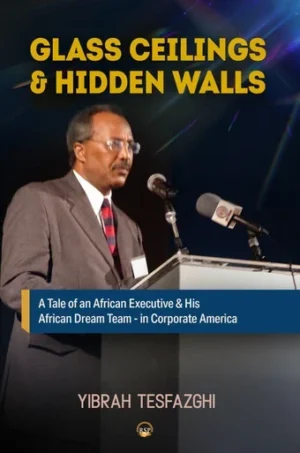
A profound exploration of leadership, identity, and the African dream in American boardrooms.
“Glass Ceilings & Hidden Walls” follows the extraordinary true-inspired journey of an African executive who rose through the ranks of corporate America armed with brilliance, cultural richness — and a dream to build something different.
When given the rare opportunity to assemble his own team, he did the unthinkable: he hired the best — and they happened to look like the world. Together, this African Dream Team would take on assignments that Wall Street insiders said couldn’t be done.
But corporate America doesn’t always celebrate what it doesn’t understand. This is also a story about navigating systems not built for you, about code-switching and code-breaking, about mentorship and betrayal, about boardrooms and back channels.
Above all, a story about what happens when African excellence meets American opportunity — and refuses to apologize for either.
format
Hardcover · Paperback · eBook (PDF & ePub)
pages
520
publisher
Red Sea Press
isbn
9781569029619 (HB) | 9781569029626 (PB)
available
April 2026
language
English
categories
Business Leadership • African Diaspora • Corporate Culture • Memoir
shipping
Global
inside the book
Born into the highland village of Sere’e in Eritrea in 1954, the author traces his earliest roots — a resilient community shaped by colonial history, Tigrigna culture, and the quiet sacrifices of a father who survived the Italian occupation. The chapter establishes the values of family, faith, and perseverance that would anchor an extraordinary global journey.
At age five, a pivotal decision by his father changes everything: he is chosen over his older brother to pursue an education in Asmara. The young Yibrah encounters the capital city for the first time — its electricity, its beds, its pasta — navigating the shock of two worlds colliding, and discovering the transformative power of education.
His aunt enrols him in school at Araba’ete Asmara, igniting a passion for learning that would define his life’s trajectory. Through high school and into Haile Selassie I University in Addis Ababa, the seeds of ambition are sown — nurtured by a mother’s sacrifice and the discipline of a young man determined to make something of himself.
A decade of crossroads: from student political activism in Addis Ababa to football glory, from Nairobi to Stockholm, from Khartoum to Saudi Arabia. Each stop sharpens the young Eritrean’s understanding of the world’s inequalities — and his resolve to rise above them. A pictorial review captures this restless, globe-spanning chapter of formation.
On March 16, 1980, Yibrah joins GE Technical Services Company in Saudi Arabia — the beginning of a remarkable 28-year career. He quickly rises through the ranks, earns a transfer to GE Corporate International, and establishes himself as a leader of rare capability in one of the world’s most powerful corporations.
A portrait of GE at its peak — from Thomas Edison’s founding vision to the leadership of Jack Welch and Jeff Immelt. The chapter contextualises the institution the author served: a global powerhouse whose culture of Six Sigma, integrity policies, and leadership development programmes shaped generations of executives — including Yibrah himself.
Appointed Regional Leader for the East Mediterranean, Yibrah relocates to Baghdad and delivers exceptional results — until the Gulf War erupts. Caught in the crossfire, he becomes a human shield, coordinates the evacuation of GE employees from Iraq under fire, and fights to secure UN compensation for GE’s losses. His integrity under pressure is tested as never before.
With the Gulf War over, Yibrah is denied the executive promotion his performance merited. A superior, motivated by spite, blocks his advancement. The chapter is an early and painful encounter with the institutional racism and personal vendettas that would become recurring themes — the first of the hidden walls the title promises.
Refusing to be sidelined, Yibrah pivots to GE Power Plant Systems Division and wins a critical victory: a landmark contract for Power Plant #9, positioning GE as the dominant energy player in the region. The chapter demonstrates his rare ability to turn institutional adversity into strategic opportunity.
A deliberate and organised attempt to destroy his career. A new project manager is brought in from outside GE specifically to undermine him. False allegations are levelled. Investigators are flown in from the United States. After a gruelling investigation, Yibrah is fully exonerated — while the real wrongdoer is found guilty. The human toll of corporate betrayal is counted in full.
Vindication renews determination. Yibrah invests in himself with a rigorous programme of GE’s most prestigious development courses: Six Sigma, the Finance Management Programme, the Manager Development Course, and GE Corporate Audit. Each credential is a building block toward the leadership destiny he has never stopped pursuing.
In April 2003, the call comes: Yibrah is appointed President & CEO of GE Africa — becoming one of the first African executives to lead a GE region on the continent. He sets three bold objectives: establish a new Sub-Saharan headquarters, deliver GE’s corporate citizenship to Africa, and build the GE Africa Dream Team. The history-making chapter begins.
Against the scepticism of GE Corporate leadership in Brussels — who cite “security concerns” as cover for indifference — Yibrah fights to establish GE Africa’s regional headquarters in Sub-Saharan Africa. The battle to be taken seriously on his own continent begins at the top of the organisation.
Determined that GE’s presence in Africa should mean more than profit extraction, Yibrah launches a corporate citizenship programme — beginning in Ghana — that delivers healthcare, education, and community infrastructure across the continent. It is a blueprint for responsible business that GE had never attempted at this scale in Africa before.
Determined that GE’s presence in Africa should mean more than profit extraction, Yibrah launches a corporate citizenship programme — beginning in Ghana — that delivers healthcare, education, and community infrastructure across the continent. It is a blueprint for responsible business that GE had never attempted at this scale in Africa before.
The team is mobilised. Yibrah’s message to African clients is grounded in clarity: GE Africa and African nations share a common stake in the continent’s infrastructure future. The chapter documents the team’s rallying purpose — to serve not just a corporation’s bottom line, but Africa’s long-term development with integrity at its core.
The GE Africa Dream Team discovers that GE’s global leadership has a deeply distorted view of Africa — shaped entirely by Western media narratives of crisis and helplessness. Yibrah maps out a six-point strategy to change this perception from within: assembling the team, feeling the ground, demystifying Africa, influencing decision-makers, creating excitement, and deepening GE’s Africa IQ.
GE had maintained a presence in Africa since 1898 — but only in Apartheid South Africa and Egypt. Yibrah’s mission is to plant GE’s flag across the continent’s 54 nations. The chapter outlines the GE Africa business methodology, the hallmark growth behaviours, and the SWOT strategic compass that guided the team’s expansion.
A deeply personal chapter: Yibrah discovers he is the only African executive among approximately 2,000 GE employees across the continent. He responds not with bitterness but with strategy — charting a deliberate path of continuous learning and leadership development, offering a framework that any professional navigating institutional barriers can apply.
In a region where corruption was endemic and third-party agents tested every boundary, Yibrah built GE Africa’s entire growth strategy on integrity as a competitive advantage. Compliance was not a constraint — it was a differentiator. This chapter is a masterclass in ethical leadership under pressure.
From a candlelit negotiating room in Abuja to the broader landscape of African governance, Yibrah examines the political forces shaping the continent: clan politics, the colonial lie of African intellectual inferiority, the hidden walls within Africa itself, and the generation of African youth who hold the power to break the spell of post-colonial stagnation.
A forensic examination of how corruption — domestic and foreign — has strangled Africa’s economic potential. From offshore banking and money laundering to Western corporations’ complicity in grand theft, Yibrah traces the three stages of illicit financial flows and calls for structural reform rooted in African sovereignty.
Invoking Kwame Nkrumah’s warning that “neocolonialism is the worst form of imperialism,” Yibrah delivers a searing analysis of eight Western neocolonial theories and policies — from debt-trap diplomacy and contraceptive policy to media weaponisation and NGO colonialism. Africa’s poverty, he argues, is not accidental. It is engineered.
Racism was not abstract — it operated inside GE’s own MEA regional offices. Hiring processes were rigged. Promotions were denied. In Saudi Arabia, in airport customs halls, in corporate corridors, Yibrah encountered racism as a daily operational reality. This chapter names it, documents it, and challenges every institution to confront it.
To forge the GE Africa Dream Team into an unbreakable unit, Yibrah leads them up Africa’s highest peak — Mount Kilimanjaro, 5,896 metres above sea level. The seven-day ascent becomes a crucible of trust, resilience, and shared purpose. What the team achieves on that mountain mirrors what they would achieve across the continent.
The descent from Kilimanjaro delivers an immediate gut punch: GE Corporate announces the creation of a Middle East & Africa “MEA” mega-region, folding Africa under Arab leadership and effectively dismantling the autonomy Yibrah had built. He submits a resignation, receives written assurances, and returns — only to discover the assurances are worthless.
GE’s globally celebrated 2004 Annual Report is published — and Africa is erased from it entirely. Despite the GE Africa Dream Team’s historic revenue growth and documented achievements, the continent does not appear. Yibrah sees it for what it is: institutional erasure, a message about whose contributions are deemed worthy of the record.
Western market research on Africa was, in Yibrah’s assessment, fundamentally flawed. He built his own intelligence — country by country — and used it to sell two propositions simultaneously: to GE’s corporate leadership that Africa was worth investing in, and to African governments that GE was a partner worth trusting. The chapter reveals the art of advocacy from the inside.
To shift GE Corporate’s deep-seated reluctance, Yibrah orchestrated a programme of executive immersion — bringing GE’s global leaders directly onto African soil through trade missions, summits, and field visits. Seeing Africa with their own eyes, rather than through media distortion, was the only strategy that changed minds.
Based on exhaustive on-the-ground research, GE Africa presented a comprehensive long-term investment plan to GE’s European leadership — covering energy infrastructure, manufacturing, and local market development across the continent. The chapter includes detailed analysis of Kenya as a model investment destination, complete with incentives, guarantees, and strategic rationale.
Managing a network of offices across a continent the size of Africa demanded a unique operational discipline. Yibrah developed comprehensive remote office policies to address corruption risks, compliance gaps, and the tyranny of distance — while documenting GE Financial Services’ achievements as proof of what principled remote leadership could deliver.
The GE Africa Dream Team’s comprehensive economic intelligence report on the continent — sector by sector, country by country — delivered to GE Corporate in 2004. Natural resources, infrastructure deficits, political terrain, growth rates, and domestic reform initiatives are mapped with the precision of a team that had actually walked the ground.
With scores of opportunities identified, GE Africa needed a prioritisation framework. This chapter presents the targeted “fast-track” portfolio: the South Africa 2010 FIFA World Cup infrastructure programme, major port expansions, and the mega-projects that offered the quickest path to transformative revenue and continental impact.
A competitive intelligence assessment of GE’s primary rivals across Africa’s key sectors — with Siemens, ABB, and Alstom occupying various market positions by 2007. Yibrah’s team mapped competitor pricing strategies, local relationships, and sector dominance to sharpen GE Africa’s differentiation and positioning.
China was GE Africa’s primary competitor — and unlike any rival before it. The chapter delivers a searching analysis of China’s Africa strategy: its “Five Nos” development philosophy, its infrastructure-for-resources model, its state-backed financing, and the candid GE-China dialogue Yibrah experienced in Nairobi. He holds both the opportunities and the contradictions in honest view.
In 2004, Yibrah conceived a bold strategy to permanently embed GE in Africa’s future: “Africanize GE” — building local leadership pipelines, manufacturing capacity, and institutional partnerships to ensure GE’s presence would outlast any individual leader. The chapter outlines the NEPAD partnership and the strategic framework designed to make GE Africa irreplaceable.
GE Africa’s strategic vision rested on a conviction: that Africa’s economic rise was real, measurable, and systematically misrepresented by Western institutions. This chapter dismantles the myths — tracking the evolution from the OAU to the African Union, and documenting the continent’s genuine growth trajectory that GE Corporate in Brussels refused to see.
South Africa’s Broad-Based Black Economic Empowerment programme was both a moral necessity and an operational complexity for GE. This chapter examines the historical context — from the US Congress’s Comprehensive Anti-Apartheid Act of 1986 — through to the practical challenges GE faced in complying with B-BBEE while competing for South Africa’s infrastructure contracts.
GE Africa leveraged the US Millennium Challenge Corporation’s country-level compacts as a strategic gateway — partnering with African nations to align development needs with GE’s industrial capabilities. The chapter outlines the Company-to-Country methodology and the selection criteria that made MCC partnerships a powerful engine for principled growth.
The Democratic Republic of Congo’s Grand Inga hydroelectric project — with a potential capacity estimated at 100,000 megawatts — represented the largest clean energy opportunity in human history. Yibrah positioned GE Africa to lead it. The chapter documents the full strategic case: capability mapping, partnership building, risk assessment, and why this landmark opportunity ultimately slipped away.
The Growth Playbook was Yibrah’s masterpiece of strategic architecture — a continent-wide roadmap that moved GE beyond transactional selling toward transformative, sustainable partnership. It spotlighted mega-projects, empowered local talent, mapped the competition, and institutionalised growth as a permanent feature of GE’s Africa identity.
Country by country, the GE Africa President & CEO documents the outcomes of his travels: Ghana, Botswana, Egypt, Tunisia, Angola, Libya, Kenya, Rwanda, Nigeria, South Africa and more — each a story of opportunity identified, relationships forged, and infrastructure deals pursued. A rare presidential-level view of corporate Africa-building, including one-on-one meetings with heads of state.
To accelerate GE’s visibility and credibility across the continent, Yibrah conceived and executed “GE Day” — large-scale industrial exhibitions in Cairo, Johannesburg, Nairobi, Luanda, Maputo, and Abuja. Each event showcased GE’s full portfolio and convened government ministers, energy regulators, and business leaders. The chapter includes a letter from Nigeria’s President Yar’Adua.
Seven landmark achievements that defined GE Africa’s transformative era: unlocking $100 billion in mega-opportunities, the birth of the Iquembu commercial team, rail transportation competitiveness, the Crotonville Inga River leadership class, GE Mining Verticals, the launch of CNBC Africa, and the GE Customer Summit CEO Programme. Each one a proof point of what African-led enterprise could accomplish.
The distilled philosophy behind GE Africa’s success: seven tenets — from turning integrity into competitive advantage, to facing China, to creating Africa-specific business models — that any leader seeking to build sustainably on the continent must understand. This chapter is Yibrah’s definitive leadership manifesto for doing business in Africa with purpose.
Recognition finally arrives: GE Africa receives the Corporate Heroes of Growth Award, followed by awards from Wharton Business School, the African Affinity Forum Europe, and BusinessinAfrica Magazine. The accolades are not the point — but they are evidence that the work was real and the impact undeniable, even as institutional forces were already moving to dismantle it.
In early 2005, Yibrah laid the groundwork for an annual business conference between GE and NEPAD — the African Union’s flagship development framework. The GE-AU Alliance was designed to permanently embed the world’s leading infrastructure company in Africa’s continental development agenda. A visionary partnership that corporate resistance would never allow to reach its potential.
Understanding that GE Africa’s long-term growth required a strong pipeline of African women in leadership, Yibrah championed the creation of a Women’s Network within GE Africa — a voluntary, mission-driven organisation to identify, develop, and advance high-potential women into senior roles. Another first for the continent that GE Corporate in Brussels quietly ignored.
In 2007, team members Allan Kilavuka and Swaady Martin approached Yibrah with a proposal modelled on GE’s African American Forum in the USA: a GE Africa Forum to support and develop African talent within GE globally. The GE Africa Asili Forum was born — and immediately encountered institutional resistance that would foreshadow the coming storm.
GE Africa had grown from $150 million in 2003 to nearly $3 billion by 2008. Then the dismantling began. Nepotism, racial jealousy, and a coordinated campaign of institutional sabotage systematically stripped the team of authority, resources, and recognition. The ombuds process was abused. Corporate leadership stayed silent. This chapter is the full, documented account of how a world-class African achievement was destroyed from within.
Abandoned by GE Corporate, Yibrah resigns and begins the humbling process of rebuilding. He searches within GE’s business divisions, navigates a difficult career transition, and eventually joins GE Energy — before the backlash that follows his departure makes the full cost of institutional courage unmistakably clear. Through it all, his family bears the weight alongside him.
By end of 2008, every member of the GE Africa Dream Team had resigned. What followed was a documented institutional collapse: the degradation of corporate citizenship, the collapse of the AU alliance, the derailment of the Inga III hydro project, the rejection of the Asili Forum, and the failure to establish African manufacturing capacity. The chapter is a sombre catalogue of what could have been — and who chose to destroy it.
In April 2018 — a decade after his departure — Yibrah submits a 60-page Ombuds claim to GE’s Senior Vice President, General Counsel, and Chairman & CEO. The claim documents years of racial discrimination, institutional abuse, and the deliberate destruction of GE Africa’s leadership. It is an act of courage, and the final formal reckoning with an organisation that chose silence over justice.
Four members of the Dream Team break their silence: Swaady Martin, Allan Kilavuka, Oswald Mkhonto, and Romel Diaz each speak in their own words about what they built, what they experienced, and what was taken from them. Their testimonies constitute a collective witness — and a powerful vindication of everything the book has documented.
Professor Loïc Sadoulet of INSEAD — Europe’s premier business school — was so struck by GE Africa’s rapid transformation that he commissioned an independent research study. This chapter presents his findings: how Yibrah and his team changed GE’s perception of Africa, built institutional knowledge, and created a business model that INSEAD identified as a global case study in leadership excellence.
The book closes where it began: in Sere’e. Inspired by Alex Haley’s “Roots,” Yibrah returns — not metaphorically, but literally — funding the construction of an elementary school and a new church in his home village. The inauguration of the Sere’e school in July 1995 is documented in photographs. The message is clear: no matter how high you climb, the village that made you deserves your best.
Hardcover • Paperback • eBook • Bulk Corporate Orders Available
Choose your preferred platform below
🔐 Secure checkout on all platforms